NMFS_Logger_Forms
MAINTAIN LOGGER LOOKUP TABLE
In the steps below, you will be generating a blank database specific to each cruise that will contain all of the information pertaining to the modules in your Pamguard settings file. This blank database however, will not contain the historical record of the field options for the Logger forms. To use those options (and create new ones) requires you to upload the master Logger form into your new database. The master Logger form is Logger_UDF_20190814_Blank_NEFSC.sqlite3.
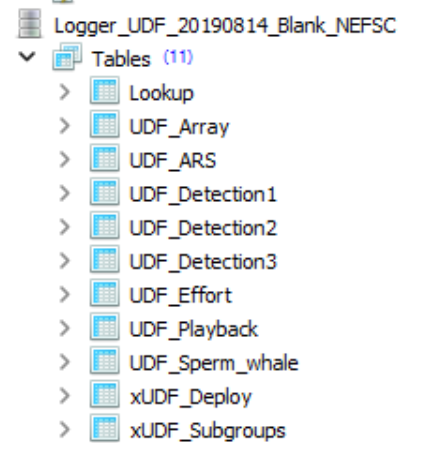
- All tables starting with “UDF” equates to a Logger form that an analyst can fill out to record cruise metadata and detection data.
- If there is an “x” preceding “UDF”, it means that form is invisible to Pamguard, but still retained in case you ever need to use it.
- Check to make sure that the forms you need for your cruise are active in the Logger file.
LOOKUP TABLE
The Lookup table within the Logger_UDF_20190814_Blank_NEFSC database contains all the reference material to populate the Logger forms.
| Field | Definition |
|---|---|
| Id | Has to be a unique ID number. Please sort this column to see the last number used. |
| Topic | General theme the field relates to (e.g., “Who”, “species”, “cruise number”). |
| DisplayOrder | Order in which the row should show up in the dropdown menu; must be unique within a Topic. |
| Code | Shortened code of the ItemText stored in database tables. |
| ItemText | Human readable short description. |
| isSelectable | Binary 1/0 to let Pamguard know whether to show that row (1) or not (0). |
The following steps should be done prior to the cruise
Make sure that the acousticians who are participating in the cruise are listed within Logger_UDF_20190814_Blank_NEFSC. If not, you can add them by inserting a new row using the green + button and filling out the Id, Topic, DisplayOrder, Code, ItemText, and isSelectable fields. The code should be the acoustician’s initials.
- If there are acousticians in the table that are not going out on your cruise, toggle them from 1 to 0 under the “isSelectable” field
Make sure that the cruise name is added to the table. This is under the “cruise number” Topic. The standard NMFS cruise code should go under Code [Ship 2 or 3 digit identifier][Last 2 digits of the year the cruise is being conducted][2 digit number referring to the order your cruise is for that particular ship]
- Toggle off any previous cruises that are still marked as 1 under “isSelectable”
There are more fine scale edits that can be made to this table, but please check in with the acoustics lead if you are going to do so
When returning from the cruise, make sure that any additions you made are copied into the master database located on the server. Check in with the acoustics lead that you have done so, or need help.
Overall NOTES
1.   Make sure that Function keys are locked ON

    1.  Hold “fn” key and press “Esc” to activate

    2.  Important on newer computers

2.  Always fill out Date/Time on each sheet
ARS

Fill out at start of each Leg and then only if something changes in the Leg
3. Acoustic Recording System
1. Settings that impact the entire ARS
1. GPS Unit: Shipboard GPS
2. Leave rest blank
4. Recorder 1 (Recording)
1. Settings for each system
1. Computer - Recorder computer
2. Sound Card - NiDAQ
3. Sampling Rate - 500000 Hz
4. High pass - 1000 Hz
5. Fill out each channel and the dB level assigned within PAMGuard module Sound Acquisition (Toolbar: Settings -\> Sound Acquisition)
5. Recorder 2 (Tracking)
1. Settings for each system
1. Computer - Tracking
2. Sound Card - NiDAQ
3. Sampling Rate - 250000 Hz (There is a decimator in place)
4. High pass - 2000 Hz
5. Fill out each channel and the dB level assigned within PAMGuard module Sound Acquisition (Toolbar: Settings -\> Sound Acquisition)
6. Click SAVEArray

Fill out at start of each leg and then only if something changes in the Leg. Example below
    1.  Array Weight: 30 lbs

    2.  Array Name 1 - Echidna array selected

    3.  Separator - 0 m

    4.  Array Name 2 – leave blank

    5.  Leave rest blank

    6.  Click SAVE
Deploy (not used for NEFSC)

Detection (1,2,3)

There can be up to 3 active detections at one time using the forms
    1.  If all you are is waiting on an End Time to close the detection and another form is needed, then Save the entry and put the End Time in the Comments Tab (ex: \*End Time AC2 06/19/2023 12:12:12)

    2.  All acoustic detection distances should be reported in meters

    3.  To save the detection there must be a minimum of 3 signals (clicks or whistles) and at a minimum record the initial bearing angle.

        1.  If never detected, write a note in the comments field that the encounter was “untraceable”

        <!-- -->

        2.  If minimum is not met make a comment in the log with what was heard and when

    4.  To signify a new group: incoming bearings must be at a smaller angle than the current group’s bearings you are tracking & the original group must be behind 90 degrees (this is because there are lots of individuals/subgroups and can be spread out)

        1.  Eg: you are tracking a group and they are at 108 degrees +/- 10 degrees. New clicks come in at 20 degrees. These new clicks would belong to a new group

        <!-- -->

        2.  For the following fields, underline= required field

3.  StartTime Date: Start of detection (auto fill using F1, but correct the time to the initial click or whistle detected on the tracking computer) by either clicking on the click in the T-B plot and reading the time off the waveform, or hovering over the end of the bearing line drawn on the map

4.  EndTime Date: Last signal (click or whistle) detected (auto fill using F1, but correct the time to the last click or whistle detected on the tracking computer) using the same methodology as in 5.c.i

5.  Location: Autofill with F1 within 2 minutes of start time

    1.  If there has been more than 2 minutes from the StartTime to filling in the field then place this comment in the Detection’s comment box (\*Edit Lat/Lon to StartTime). If you’ve made a map comment for the start of the event, you can get that value in data QAQC (\*see map comment for position of A1)

6.  Acoustic ID: Start with 1 at beginning of cruise and continue counting until end of the project (do NOT start over each Leg)

7.  Visual ID: Sighting ID number from Visual time that matches current detection

    1.  If never seen, leave blank

    <!-- -->

    2.  Initial Angle: First angle detected from either a click or whistle

    3.  Initial Distance: Location at start of localization

        1.  If never localized then fill in NA for units

    4.  Beam Distance: Perpendicular distance from the beam (90 degrees) of the array to the first subgroup of animals

        1.  With timestamp

        2.  If never localized then fill in NA for units

    5.  Detection Distance: Greatest distance animals were detected from the array. That can be the same as Initial or Beam distance.

        1.  If never localized then fill in NA for units

    6.  Localization Method: If any of the distances were measured then select Pamguard, otherwise NA.

    7.  Vocals detected: Select as many vocal types that were present at any point throughout the detection (order does not matter)

    8.  Detection Type: Acoustics or Both. Never use Visual as an option for this field. All Visual only sightings can be recorded in the User input.

    9.  First Detection: Acoustics, Visual, or Both (Whomever’s start time is earliest).

    10. Method: Acoustic Technician

    11. Species Code 1: Select species acoustics detects and fill out 2 & 3 if needed.

    12. Additional Method fields are to be filled out if Visuals has a species ID. They don’t have to match acoustics. Example: Visuals has Unid. beaked whale, but Acoustics detects Cuvier’s beaked whales. OR Visuals has sperm whales and Acoustics detects sperm whales & Unid. dolphins.

    13. Comments: Any additional information of note from the detection. If the field is filled then add additional information in the User input. Add the UID number so we can match the PAMGuard annotations to the Acoustic ID later

8.  Click SAVE
Effort

Fill out at every shift change and/or change in effort status
    1.  StartTime Date: auto fill using F1

    2.  Cruise Number: e.g. PC2501

    3.  Trackline ID: Leave empty if off the trackline, fill in the trackline number if on effort and on track

    4.  Acousticians: Those present in the chairs. The first one is the person on effort, the second one is for the standby acoustician

    5.  Effort

        1.  Acoustic: ON when acousticians are monitoring the recordings

        2.  Visual: ON when members of the Visual team are on the flying bridge (or bridge) regardless of their effort status. Make a comment if they are on weather watch (PIFSC surveys, for NEFSC the chief sci does this)

        3.  Recording: ON when data is being collected

        4.  Other effort: echosounder status (ON/OFF)

    6.  Real-time Monitoring: Select the channels being monitored on the tracking computer

    7.  Sound speed: enter the soundspeed from the most recent bongo

    8.  Sea state: if an observer is in the dry lab ask them, otherwise determine it yourself

    9.  Leave the rest blank

    <!-- -->

    2.  Click SAVE
Sperm whale (NEFSC only)

1.  Start/End Time

2.  Start/End latitude and longitude

3.  ID (46-Sperm Whale) and ID type (acoustic tech, visual, or both)

4.  Call type detected (Usual, Coda, etc)

5.  Localization not required, but feel free to practice if clicks registering on detector and nothing else is happening (NEFSC only).

6.  Comments should contain a rough estimate of how many sperm whales are in the event