load("paka_conout.rda")
paka <- out_newDay 3
Objectives
- Walk through an example of a plot and table from {stockplotr}
- Learn about the value of the {stockplotr} R package
- Understand how to integrate {stockplotr} into an {asar}-based reporting workflow
- Understand how to add accessibility features to the report
Introduction
Icebreaker
Welcome! Please open the Day 3 communal notes doc and participate in the icebreaker exercise.
Tip
Reminder: For comments or questions, please raise your hand, or write them in the chat, at any time. Depending on our schedule, we may ask that you save larger questions for breaks.
Materials for today’s lesson
- Day 3 communal notes doc
- Contains resources (from us and you!) and areas for note-taking
- Sample data
- Sample model output data for coding demonstrations
- Example figure
- Example figure (in .png format) for coding demonstration
Installation
{asar}, {stockplotr}, {quarto}, and {tinytex} should already be installed if you attended Days 1 or 2. If not, please install these packages by following the instructions in the pre-workshop checklist.
Introduction to {stockplotr}
Import converted model results
First, you’ll need to import a set of converted model results. You can 1) load in already-converted model results, or 2) convert model results again.
Load in converted model results
If you have already converted your output: great! Import it into your R environment so that you can handle it as an object like “paka”. For example:
Convert model results
If you need to convert model results into a standardized format again, you can use the same workflow covered yesterday: stockplotr::convert_output().
You can use the example Report.sso file uploaded to the workshop GitHub or, if you have a compatible output file, your own.
# Identify output file
output_file <- file.path("example_output", "Report.sso")
# convert the output and save it as an rda
paka <- stockplotr::convert_output(output_file,
                                      save_dir = file.path(getwd(), "paka_conout.rda")
)Package information
This package is an ongoing process to gather contributions in order to expand the number of pre-made tables and figures that can be incorporated into a stock assessment report. All objects are intended to be generalized and not specific to any region.
{stockplotr} also contains convert_output(): the function used to convert model results into a standardized output (as explained in a previous section). This standardized output is the input for the {stockplotr} plotting functions, below (the dat argument).
The following table contains figures and tables that are available in {stockplotr}:
| Function | Description |
|---|---|
plot_abundance_at_age() |
abundance-at-age |
plot_biomass_at_age() |
biomass-at-age |
plot_biomass() |
biomass time series |
plot_catch_comp() |
catch compositions |
plot_fishing_mortality |
fishing mortality time series |
plot_indices() |
indices |
plot_landings() |
landings time series |
plot_natural_mortality() |
natural mortality time series or at-age |
plot_recruitment_deviations() |
recruitment deviations |
plot_recruitment() |
recruitment time series |
plot_spawn_recruitment() |
spawn recruitment relationship |
plot_spawning_biomass() |
spawning biomass time series |
table_landings() |
landings time series by fleet or other indexing |
table_bnc()- coming soon |
biomass, landings, and catch time series |
table_harvest_projection()- coming soon |
harvest projection table according to SAFE standards (to be expanded nationally) |
tables_indices()- coming soon |
indices by fleet |
Each automated function returns either a ggplot2 object (figure) or gt object (table). This allows for further customization of the output if desired by using the notation you are familiar with. For a figure, you can continue to add onto the plot any other ggplot2 function or extension using the plus (+) operator. For a table, please use the native pipe (|>) when adding additional formatting, rows, or other pieces to the object.
Example Figure
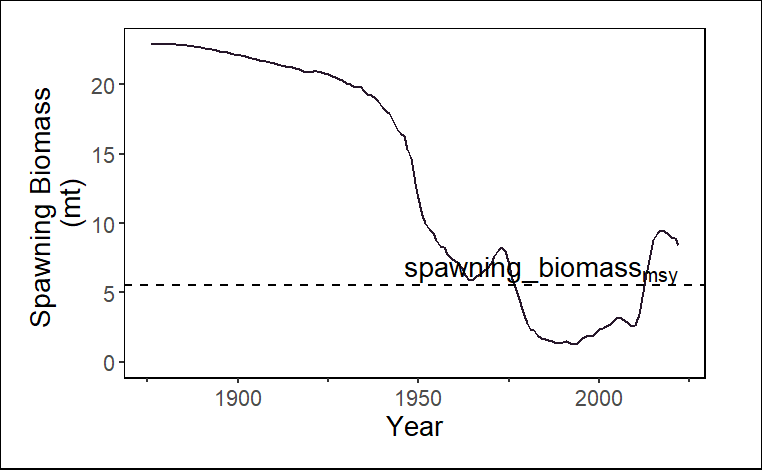
Run the example below. It should result in a line graph showing spawning biomass over time, including a reference line for the spawning biomass at msy.
library(stockplotr)
plot_spawning_biomass(
  dat = paka, # dataset
  geom = "line", # show a line graph
  group = NULL, # don't group by sex, fleet, etc.
  facet = NULL, # not faceting by any variable
  era = NULL, # default to "time"
  ref_line = "msy", # set reference line at msy
  unit_label = "mt", # unit label: metric tons
  scale_amount = 1, # do not scale spawning biomass
  relative = FALSE, # show spawning biomass, NOT relative spawning biomass
  interactive = TRUE, # prompt user for MODULE_NAME in console
  module = NULL # MODULE_NAME not specified here
)
Tip
Remove the legend by adding this code directly onto your original plot_spawning_biomass() code:
+ ggplot2::theme(legend.position="none")
We’ll cover customizations in more detail in a moment.
Customizing
All figures will automatically identify any indexing variables in the data such as fleet, area, or sex. You can use the group and facet arguments to modify how these indexing variables are displayed in the figure. You can also modify other arguments such as geom, ref_line, and relative to change the appearance of the figure.
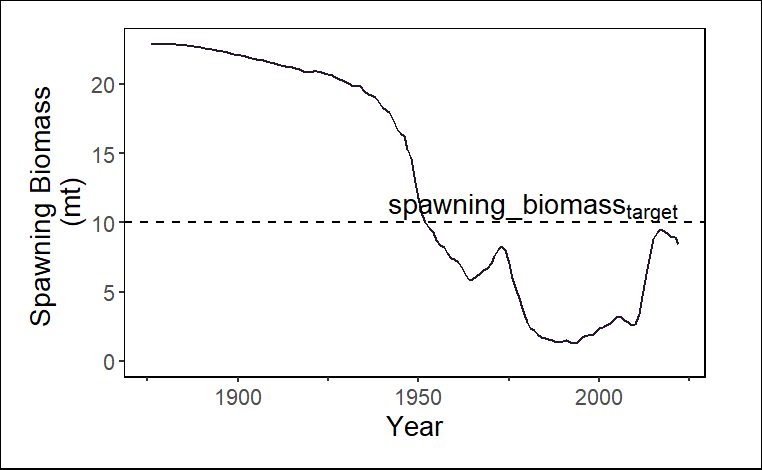
Change the reference line to a specific value (e.g., 10), or remove it
In this example we are also telling the function which module to select in order to by-pass this step. We plan to remove grouping of some modules in the future.
You can remove the reference line by setting ref_line = NULL.
plot_spawning_biomass(
  dat = paka,
  geom = "line",
  group = NULL,
  facet = NULL,
  era = NULL,
  ref_line = c("target" = 1200), # changed from "msy"
  unit_label = "mt",
  scale_amount = 1,
  relative = FALSE,
  interactive = FALSE, # changed from TRUE
  module = "DERIVED_QUANTITIES" # indicate module name here
)
Tip
To show plots in lbs, set the lbs argument in plot_spawning_biomass() to TRUE.
Customizations from {ggplot2}
In this example, we still are bypassing module selection and we are automatically extracting the reference line value from the data. However, now we are using this reference value to plot relative spawning biomass and changing the linewidth to 2 (an argument inherited from ggplot2::geom_line()) as well as adding a vertical reference line at 2005 to highlight some point in time. Both of these customizations use functionality from {ggplot2} that is not explicit in {stockplotr}!
Note
If you were plotting a scatterplot (geom = 'point') or area plot (geom = 'area'), you could add arguments associated with geom_point() and geom_area(), respectively.
plot_spawning_biomass(
  dat = paka,
  era = NULL,
  ref_line = c("target" = 1200),
  module = "DERIVED_QUANTITIES",
  linewidth = 2 # increase width of lines
) +
  ggplot2::geom_vline(xintercept = 2005, linetype = "dashed", color = "red") +
  ggplot2::theme(legend.position = "none")
Tip
The only extended arguments available are the ones found from the ggplot2::geom_XX() function. Thus, any indexed variables can not be changes such as color to fill. Please see the documentation for ggplot2 geom functions for these additional arguments.
Example Table
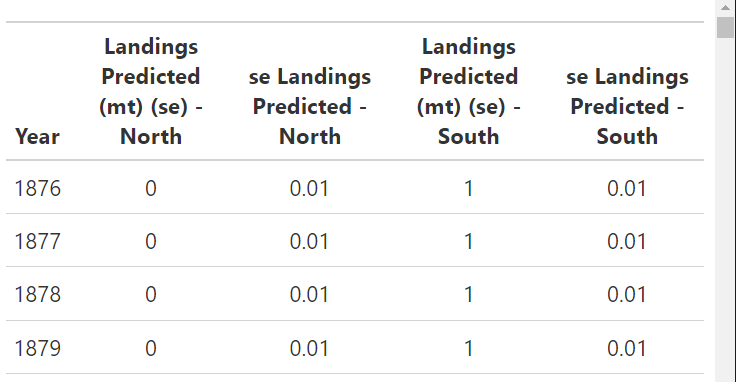
Run the following example table. The result is a fully report ready table showing landings over time. Remember that these are exported as gt objects and can be edited as such.
Note
{stockplotr} uses the native pipe (|>), so if you decide to customize you table, please also use the native pipe to avoid errors.
stockplotr::table_landings(
    dat = paka,
    unit_label = "mt",
    module = "CATCH"
)
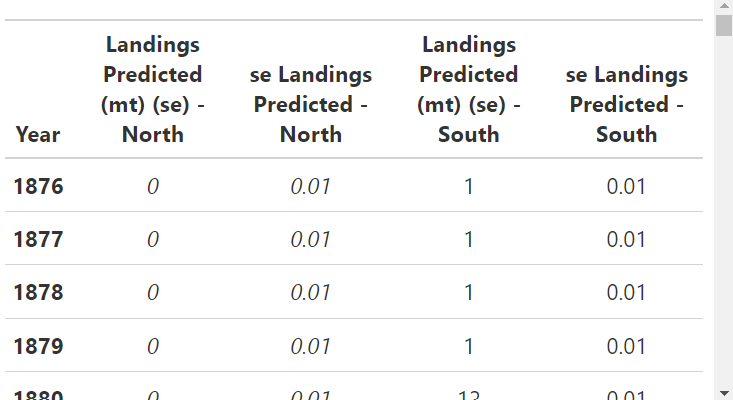
Next, we can add some different formatting:
library(gt)
stockplotr::table_landings(
    dat = paka,
    unit_label = "mt",
    module = "CATCH")[[1]] |> # [[1]] pulls the gt table from the list. Saving as an object and pulling "list" also works (e.g., table$list)
  gt::tab_style(
        style = cell_text(weight = "bold"),
        locations = cells_body(columns = "Year")
    ) |>
  gt::tab_style(
        style = cell_text(style = "italic"),
        locations = cells_body(columns = 2:3)
    )
Tip
Check out the {stockplotr} cheatsheet to quickly reference the main concepts of this package!
Exporting
You can export any table or plot along with their associated caption and alternative text (figures only) in the format of an rda file. An rda is an R data file that stores R objects and preserves their structure. In this case, you can think of an rda file exported from {stockplotr} as a list of objects.
Each plot or table has the option to export it as an rda. This rda is a list of 3 associated components for the plot/table to be used in a stock assessment report:
ggplot2orgtobject- caption
- alternative text (figures only)
- LaTeX object (tables only)
plot_spawning_biomass(
  dat = paka,
  ref_line = c("target" = 10),
  unit_label = "mt",
  module = "TIME_SERIES",
  make_rda = TRUE,
  figures_dir = getwd() # indicate where to create a "figures" folder with the spawning biomass figure rda
)
Let’s explore the rda’s components.
load("figures/spawning_biomass_figure.rda")
rda$figure
rda$caption
rda$alt_textNow, export the landings table:
table_landings(
  dat = paka,
  make_rda = TRUE, # new argument needed to export plot
  tables_dir = getwd() # indicate where to create a "tables" folder with the landings table rda
)
Import the table rda and explore it:
load("tables/landings_table.rda")
rda$table
rda$caption
rda$latex_table
Tip
We have designed two functions that allow you to automatically create all available figures and tables:
save_all_plots()
Integrating {stockplotr} into the workflow
For the second half of today’s lesson, let’s reorient ourselves. We’ve just learned how to make figures and tables with {stockplotr}. Now, we’ll cover how to add those plots into your {asar} report template.
Remember that after running the primary {asar} function– create_template()- you have a ‘report’ folder with several files in it. These files include the report skeleton; the child documents containing the executive summary, introduction, results, and so on; and, importantly for us right now, the documents that will contain code to display your figures and tables. The files will be named something like ‘08_tables.qmd’ and ‘09_figures.qmd’ (the prefix numbers may vary).
Each file will contain zero figures or tables. Instead, they will contain a statement referring you to {stockplotr} so that you can make your own. Since we’ve created those already, let’s add them to your report!
Reminder: we are going to proceed in working with the original report you created yesterday, located in the “report” folder. This folder contains a document with the example paragraph, model results, and more.
Adding tables and figures to your report
You can add your figures and tables with two workflows:
- Running
asar::create_tables_doc()andasar::create_figures_doc()
- If you fill in arguments that allow R to find your tables and figures, then it will place them into the respective tables and figures docs automatically.
- Adding your tables and figures manually to each doc.
Option 1: Running asar::create_tables_doc()/asar::create_figures_doc()
This is also known as the rda-based workflow.
Figures
To add figures, first ensure that your folder containing the figures is called “figures”.
Then, there are only two arguments to fill out:
subdir: The location where the new figures doc should be saved (we recommend your ‘report’ folder, so it overwrites the old, empty version)figures_dir: The location of your “figures” folder
library(asar)
create_figures_doc(
  subdir = fs::path(getwd(), "report"), # indicates the new figures doc will be saved in your "report" folder, located in the working directory
  figures_dir = getwd() # indicates your "figures" folder is located in the working directory
                  )
Now, open your new figures doc and take a look!
You’ll notice the following structure:
Chunk 1 will always create an object saving the location of your figures_dir.
Then, there will be at least two chunks for each figure. For each figure,
Chunk 2 will:
- load an rda containing a figure
- give the rda a specific name
- save the figure, caption, and alternative text as separate objects
Chunk 3 will:
- display the figure
Tables
Adding tables entails nearly the same process as described for figures. The only differences are:
- Tables will involve captions only, whereas figure require captions and alternative text
- Tables can be rotated or split across pages.
To add tables to the {asar} tables doc:
library(asar)
create_tables_doc(
  subdir = fs::path(getwd(), "report"),
  tables_dir = getwd()
  )
Important
Our workflow can accommodate tables that are wide enough to require rotation into a landscape-view page OR splitting across pages. For more information, please see the “Adding Custom Figures & Tables” vignette.
CautionPractice exercises: Creating {stockplotr} figures & tables
For the following, use stockplotr::example_data as the input data.
- Create an abundance-at-age plot. Export it as an rda to your working directory.
- Create a recruitment time series plot. Change the
unit_labelandscale_amountso that the y axis shows recruitment in thousands of fish. Setmodule= “TIME_SERIES”. - Create a fishing mortality plot. Ensure it does not group by fleet. Set
module= “TIME_SERIES”. Add a reference line (“target”) at 0.5. Convert it from a line plot to a scatterplot. - Create a landings table.
Now, use your own data.
- Convert your own dataset using
convert_output(). - Create a spawning biomass plot. Change the theme by applying the
ggplot2::theme_classic().
CautionAnswers for Practice exercises: Creating {stockplotr} figures & tables
For the following, use stockplotr::example_data as the input data.
- Create an abundance-at-age plot. Export it as an rda to your working directory.
Answer:
stockplotr::plot_abundance_at_age(
  dat = stockplotr::example_data,
  make_rda = TRUE,
  figures_dir = getwd()
)- Create a recruitment time series plot. Change the
unit_labelandscale_amountso that the y axis shows recruitment in thousands of fish. Setmodule= “TIME_SERIES”.
Answer:
stockplotr::plot_recruitment(
  dat = stockplotr::example_data,
  unit_label = "fish",
  scale_amount = 1000,
  module = "TIME_SERIES"
)- Create a fishing mortality plot. Ensure it does not group by fleet. Set
module= “TIME_SERIES”. Add a reference line (“target”) at 0.5. Convert it from a line plot to a scatterplot.
Answer:
stockplotr::plot_fishing_mortality(
  dat = stockplotr::example_data,
  group = "none",
  module = "TIME_SERIES",
  ref_line = c("target" = 0.5),
  geom = "point"
)- Create a landings table.
Answer:
stockplotr::table_landings(
  dat = stockplotr::example_data
)
Now, use your own data.
- Convert your own dataset using
convert_output().
Answer:
convert_output(
  file = "path/to/your_report_file"
  # Specify these arguments if you wish: model, fleet_names,   save_dir
)- Create a spawning biomass plot. Change the theme by applying the
ggplot2::theme_classic().
Answer:
stockplotr::plot_spawning_biomass(
  dat = your_converted_data_object
) +
  ggplot2::theme_classic()
Option 2: Manually adding tables/figures
Tables
You can add a regularly-sized1 table/figure manually by following these main steps:
- Create a code chunk
- Add your label and other chunk options
- Add code
- Write caption
- Add a page break between tables (optional but recommended)
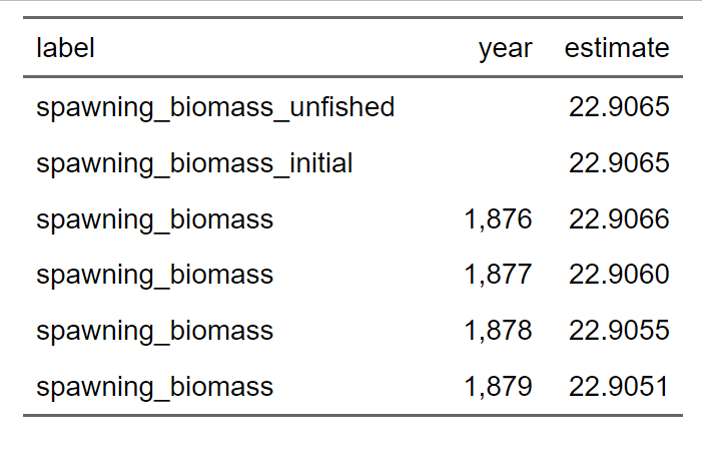
Direct coding-in-qmd table workflow
Example similar to that in the “Adding Custom Tables & Figures” vignette:
```{r}
#| label: 'tbl-direct_code_table1' # choose a label
#| echo: false # don't show the code- only the output (table)
#| tbl-pos: 'h!' # display the table after "Tables" header
#| tbl-cap: This is your table caption.

# Import your data
load(fs::path("paka_conout.rda"))
paka <- out_new

# Make your table
your_table <- head(paka) |>
  dplyr::select(label, year, estimate) |>
  gt::gt()

# Show your table
your_table
```
Then, add a pagebreak:
{{< pagebreak >}}
Warning
It will be important to add your captions and labels into a csv file when making your documents accessible. You will soon learn more about this in the the “Adding accessibility features” section!
Direct image-based table insertion workflow
We don’t recommended adding tables as images, since it significantly reduces the accessibility of your table. However, we understand that sometimes this is the only format available.
Use the following notation to reference an external table as an image:
{fig-alt="This is the alternative text for my table" #tbl-example}
Note
Notice how there is alternative text added to this method of adding a table. In this scenario, the table is recognized as an image and thus would NOT pass accessibility checks. Please make sure you add alternative text for image-based tables added in this way.
Figures
Direct coding-in-qmd figure workflow
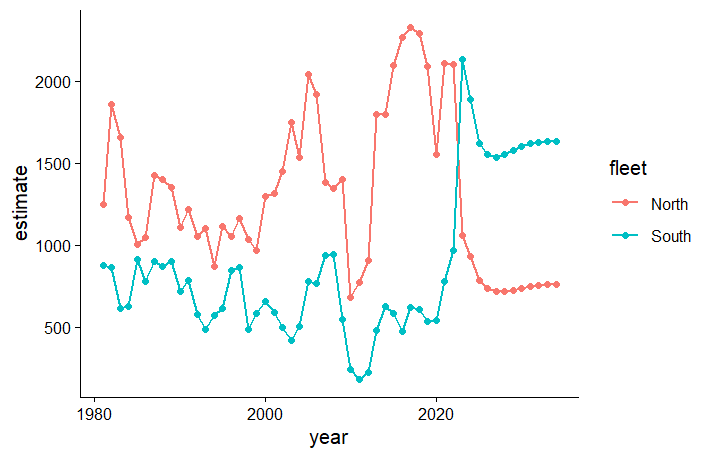
Like with tables, running create_figures_doc() produces a blank figures Quarto file. We add figures similarly to tables. In fact, the only major difference is that you must write alternative text for your figure.
Put your alternative text in a chunk option called ‘fig-alt’ (example below).
```{r}
#| label: 'fig-direct_code_figure1' # choose a label
#| echo: false # show only the output, not the code
#| fig-cap: This is your figure caption.
#| fig-alt: This is your figure alternative text.

# Import your data
load(fs::path("paka_conout.rda"))

paka2 <- out_new |>
                    dplyr::filter(year > 1980) |>
                    dplyr::filter(module_name == "TIME_SERIES") |>
                    dplyr::filter(label == "biomass")

# Make your figure
your_figure <- ggplot2::ggplot(paka2,
  ggplot2::aes(x = year, y = estimate, color = fleet)) +
  ggplot2::geom_line(linewidth = 0.75) +
  ggplot2::geom_point() +
  ggplot2::theme_classic()


# Show your figure
your_figure
``` 
Warning
Even though you wrote alt text in the fig-alt area, when you first render your report into a PDF, your alternative text will not show up in your document. Strange, right?! To ensure it shows up, refer to the “Adding accessibility features” section (which we’ll discuss in a moment).
Direct image-based figure insertion workflow
Like tables, you can reference figures not made directly in code chunks. However, in this case, this does not change the accessibility of the figure because you can still add the necessary components to meet Section 508 compliance standards: alternative text and a caption.
{fig-alt="This is the alternative text for my figure" #fig-markdown_figure1}
Referencing your tables or figures in text
Quarto uses a special notation to allow users to link tables and figures throughout their text. Use the following notation to link/reference tables in your text:
@tbl-direct_code_table1or
@fig-markdown_figure1Adding an @ symbol followed by the chunk label, or label of your table/figure, will create an interactive link that lets the reader navigate to that specific table/figure.
Render your first report draft!
Open your skeleton .qmd file, then render the report.
You can render a report in three ways:
In the R console
Run quarto::quarto_render([path/to/your/skeleton.qmd file]) in the console. For example:
quarto::quarto_render(
  file.path("report",
             "sar_H_Crimson_jobfish_skeleton.qmd") # add your skeleton filename
)
With the RStudio “render” button
Open the skeleton .qmd file. Then, in the program pane, press the “render” button:

In the terminal
Run quarto render [path/to/your/skeleton.qmd file] in the terminal. For example:
Enter quarto render report/sar_H_Crimson_jobfish_skeleton.qmd
CautionPractice exercises: Add figures/tables and render report
- Ensure that you have a ‘figures’ folder and a ‘tables’ folder, each with at least one rda file. If you don’t, export a couple of figures and tables.
- Hint: ensure that the
make_rdaargument is set to TRUE when running the {stockplotr} functions that create figures and tables).
- Hint: ensure that the
- Open up your figures and tables qmds, in the ‘report’ folder. If these documents do not contain the necessary chunks to import and display at least one plot, rerun
create_figures_doc()and/orcreate_tables_doc()to add code that will plot the figures/tables in your ‘figures’ and ‘tables’ folders.- Hint: ensure that the arguments are correct:
subdirandfigures_dir(for the figures doc) /tables_dir(for the tables doc) - Hint: This step practices the “rda-based workflow”.
- Hint: ensure that the arguments are correct:
- Practice adding a figure with markdown notation by adding the image of a landings figure into the figures doc. The figure is located in the ‘example_plots’ folder. Set the caption to “Historical landings by fleet.”, the alternative text to “Cumulative line plot showing historical landings for North and South fleets. The x axis shows the year, which spans from 1850 to 2026. The y axis shows landings in metric tons, which spans from 0 to 2,400.”, and the figure label to “practice-figure-label”.
- Hint: This step practices the “direct image-based workflow”.
- In the Executive Summary, add a reference to the first figure in your figures qmd file.

CautionAnswers for Practice exercises: Add figures/tables and render report
- Practice adding a figure with markdown notation by adding the image of a landings figure into the figures doc. The figure is located in the ‘example_plots’ folder. Set the caption to “Historical landings by fleet.”, the alternative text to “Cumulative line plot showing historical landings for North and South fleets. The x axis shows the year, which spans from 1850 to 2026. The y axis shows landings in metric tons, which spans from 0 to 2,400.”, and the figure label to “practice-figure-label”. Hint: This step practices the “direct image-based workflow”.
Answer: Add the following chunk to the figures doc:
{fig-alt="Cumulative line plot showing historical landings for North and South fleets. The x axis shows the year, which spans from 1850 to 2026. The y axis shows landings in metric tons, which spans from 0 to 2,400.", #practice-figure-label}- In the Executive Summary, add a reference to the first figure in your figures qmd file.
Answer: If the ‘label’ for that first figure is ‘fig-custom1’, then the in-text reference would be ‘@fig-custom1’.
Adding accessibility features
TipCongrats! You’re almost there!
You’ve made major progress towards completing your first report!
While your rendered report looks superb, it’s probably missing two major components: tags and alternative text.
If you made an HTML-based report, these features would most likely be in your document. But since we’re prioritizing PDFs, there are a few more steps to take before your document will significantly more accessible than it is now. This means that, to achieve compliance with Section 508 criteria, you must complete a couple more tasks.
We will use a single function to add these features to our reports: asar::add_accessibility().
Notably, this function does not work on your skeleton .qmd file. Instead, it acts on a new file in your ‘report’ folder: a LaTex-based version of your rendered skeleton .qmd file created when you rendered that skeleton .qmd file. It will have a .tex file extension and will be titled something like ‘sar_H_Crimson_jobfish_skeleton.tex’. It’s where we add our remaining accessibility features because Quarto does not yet offer that functionality within its .qmd files.
Here are the steps you must take before you run asar::add_accessibility(), and what will happen when we run it.
Tip
asar::add_accessibility() essentially combines two separate functions that add tags (asar::add_tagging()) and alternative text (asar::add_alttext()) to reports. You can run these two functions individually, if you prefer (in the order above).
Tagging
First, asar::add_accessibility() adds tags to your report.
Tags are structural elements of PDFs. They are signals telling software which information are headers, images, tables, text, and so on. Tags allow people using technology like screen readers to logically navigate PDFs.

Alternative text
You must add alternative text (“alt text”) for images in a separate csv if you added figures using any of the workflows described above. Alt text is a description of your figure that can be read aloud by a screen reader and should answer this essential question:
What is this image conveying?
Since you’ve used {stockplotr} to make some figures, you’ve already completed the first step: making a csv that will contain your alt text.
Look at your alt text csv
The file, “captions_alt_text.csv”, should be located in your working directory (enter getwd() if you forget where that is). Open it up.
The file is set up like this:
- Column 1 (“label”) is a shorthand label for your figure or table. Labels should be somewhat short and exclude spaces. Examples include “kobe”, “relative.biomass”, and “fishing.mortality”.
Important
The label in the csv must match the label in your plot’s chunk options, MINUS the “fig-” or “tab-”. For example, the label “custom_table1” in the csv would match up properly with the “tbl-custom_table1” label in this code chunk:
```{r eval=FALSE}
#| label: 'tbl-custom_table1'

my_table
```
The same rule applies for figures: “custom_figure1” in the csv would match up with “fig-custom_figure1” in the chunk options’ label.
- Column 2 (“type”) contains “figure” or “table”.
- Column 3 (“caption”) contains your caption.
- Column 4 (“alt_text”) contains alternative text for figures. For tables, this column will be blank.
| label | type | caption | alt_text |
|---|---|---|---|
| example_fig | figure | Example caption for figure. | Example alternative text for figure. |
| example_tab | table | Example caption for table. |
Update the csv
Your job is to:
- edit existing entries for your figures already created with {stockplotr}. This entails checking the accuracy, and writing the final component, of the existing alt text.
- add entries for your custom figures.
Editing existing entries
Using the “label” column, find the row associated with your figure and inspect it.
You’ll see that there’s already some prewritten alt text (in the “alt_text” column) that includes data from the model results file. Now, you must check this information for accuracy and update it where necessary (especially if the default figures were modified).
- This prewritten alt text usually contains 3/4 essential ingredients for well-written alt text. The remaining ingredient (#4): the relationship between the variables shown (i.e., what the figure is conveying). Since we can’t program {stockplotr} to analyze the figure’s meaning, you must provide this crucial component.
If you see text that looks like a placeholder (e.g., “The x axis, showing the year, spans from B.start.year to B.end.year…”), that means that there was at least one instance where our tool failed to extract a specific value from the model results, calculate a key quantity (like the start year of a biomass plot- aka “B.start.year”), and substitute it into the placeholder.
Important
While we have extracted key quantities as accurately as possible, we cannot guarantee that each quantity will have been calculated perfectly. Input data varies widely. It’s your responsibility to check the accuracy of your figures’ alt text.
When you’re satisfied, save the csv.
Adding new entries
- Make a new row.
- For “label”, take the “label” of your figure chunk.
- For figures coded in chunks, our example label would be “fig-custom1”.
- For figures added with markdown2 (i.e., premade pngs or jpgs), our example label would be “fig-example”.
- The type will be “figure”.
- The caption should be identical to the caption in your chunk (what you put in “fig-cap”).
- The “alt_text” will contain your alt text. See the “Editing existing entries” section above, and the “Achieve Greater Accessibility” vignette, for help writing alt text.
When you’re satisfied, save the csv.
Shortcut: Run this code to automatically add a row to your alt text/captions csv with sample data for an example “abcde” figure (label = “fig-abcde”):
# Make small data frame with abcde figure's information
new_row <- data.frame(
  label = "abcde", # identical to the chunk label ("fig-abcde") MINUS "fig-"
  type = "figure",
  caption = "My example figure caption.",
  alt_text = "My example figure alt text."
)

# path to captions/alt text csv (edit as needed)
csv_path <- file.path(getwd(), "captions_alt_text.csv")
# read existing captions/alt text csv file
captions_alt_text <- read.csv(csv_path)
# add new row(s)
captions_alt_text <- rbind(captions_alt_text, new_row)

# write updated captions/alt text csv file
write.csv(
  captions_alt_text,
  file = csv_path,
  row.names = FALSE
)
Add tagging and alt text to your report
Now, we’re ready to use the asar::add_accessibility() function to add tags and alt text into the report’s .tex file.
add_accessibility(
    x = "sar_H_Crimson_jobfish_skeleton.tex", # your .tex report file
    dir = "report", # the folder containing the .tex file
    alttext_csv = "captions_alt_text.csv", # the filename of your csv with captions and alt text, located in the working directory
    rename = "Crimson_jobfish_tagged", # the name of the new, accessible PDF
    compile = TRUE # we'll compile the PDF
  )
Check the tags
Now your PDF is tagged! Once you open the tag menu, you’ll see the tags on the right side of the PDF viewer.
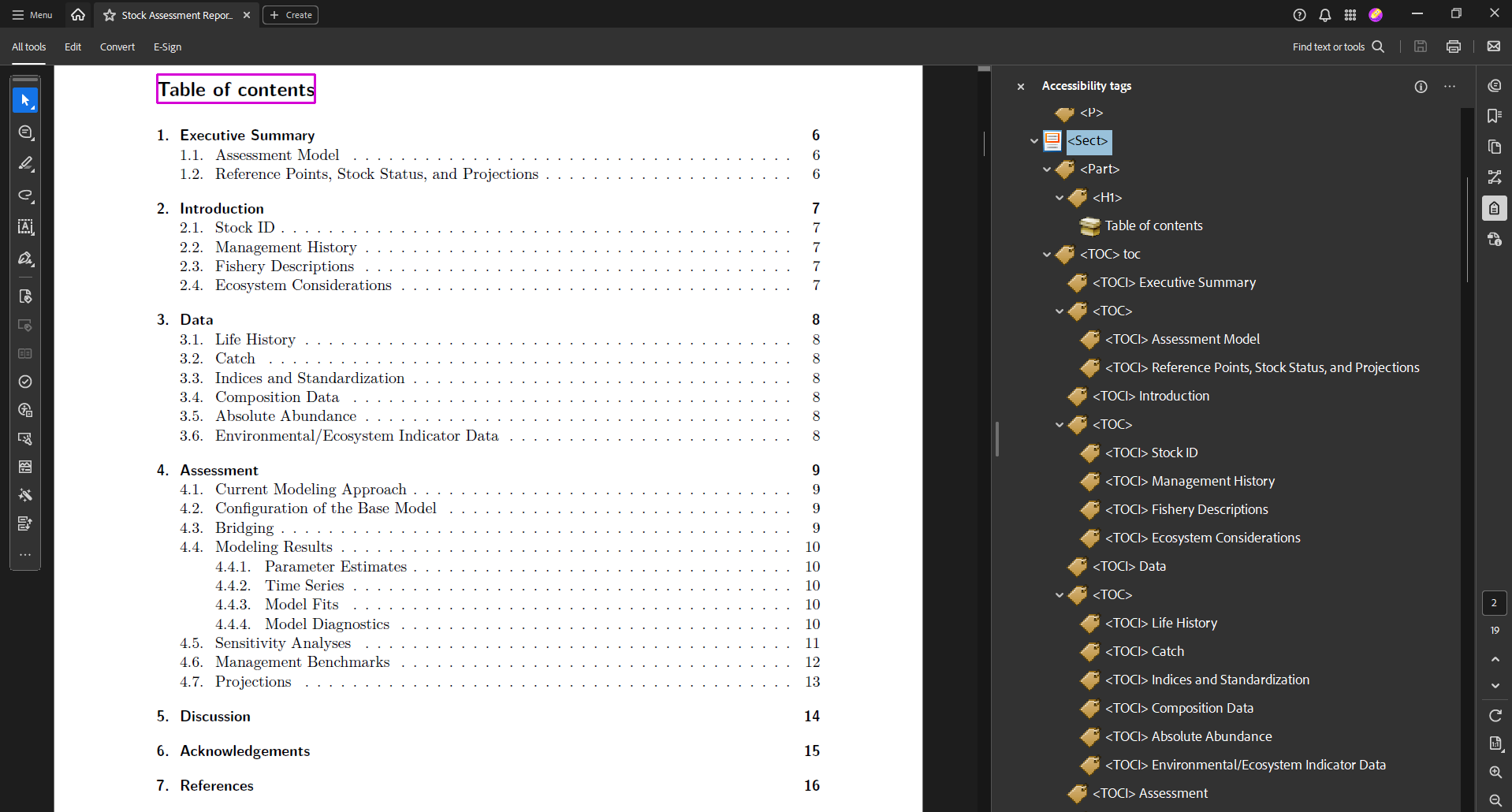
Check the alt text
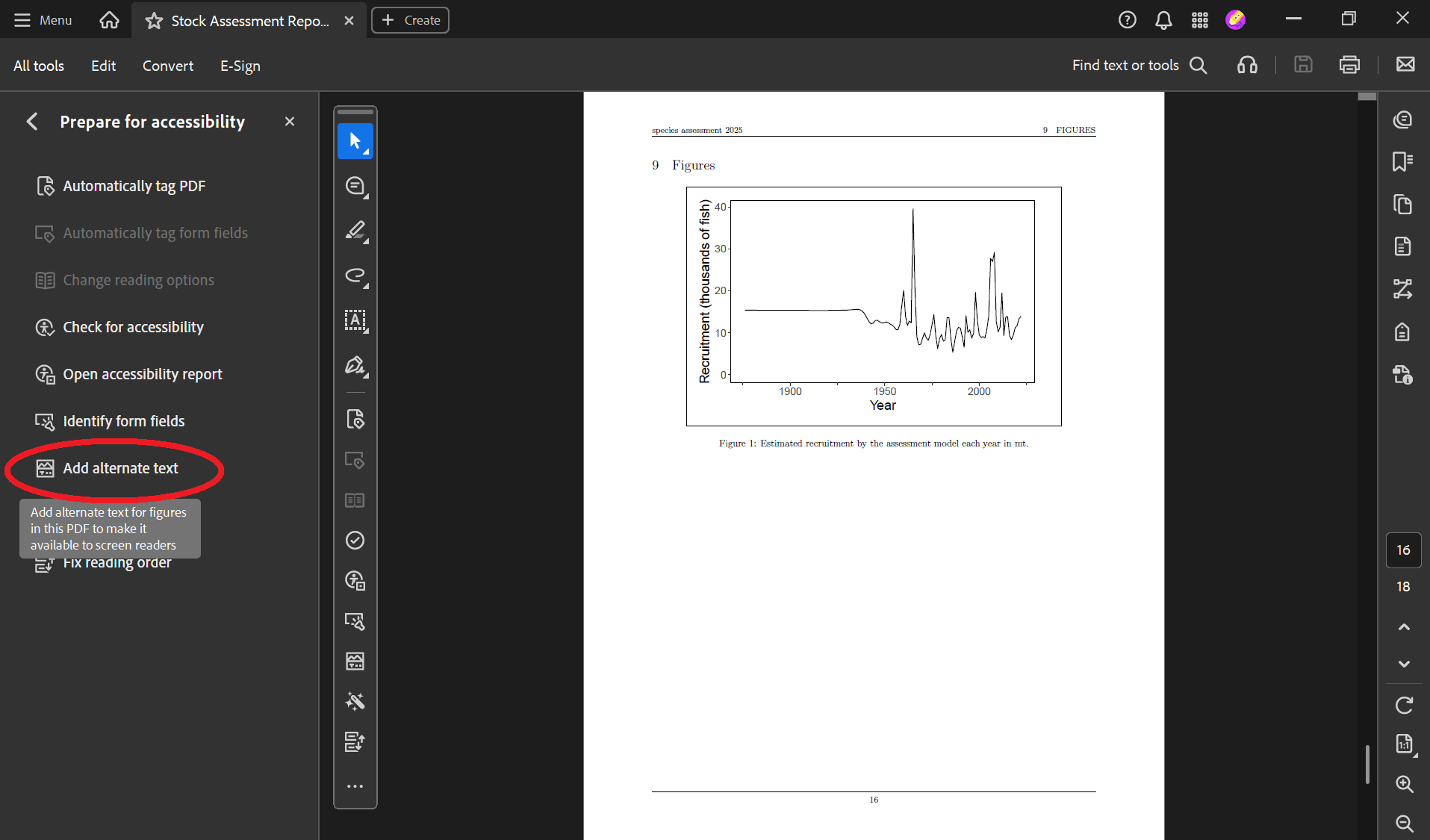
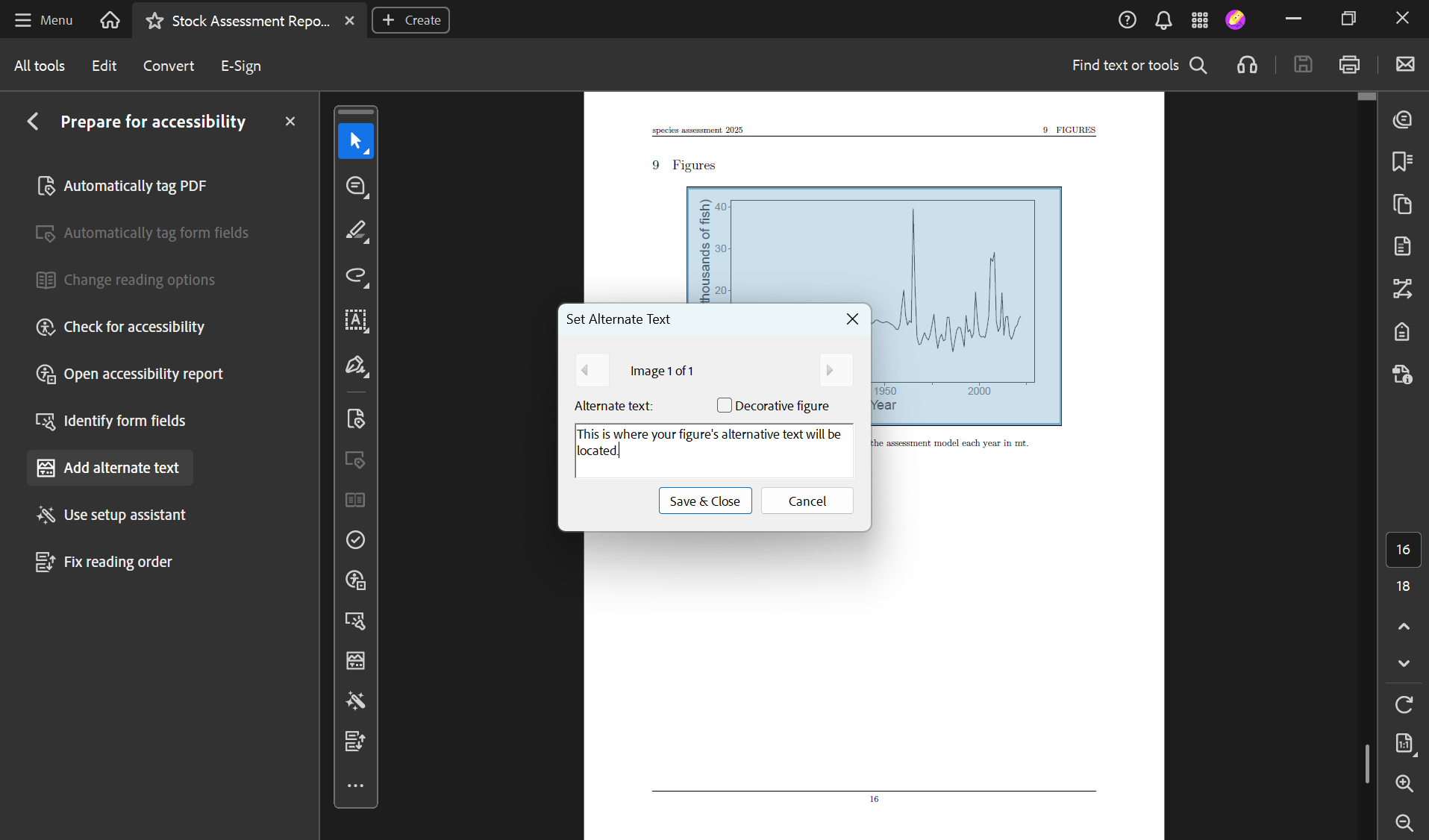
Now your PDF’s figures have alt text! You can find and edit the alt text by following these steps:
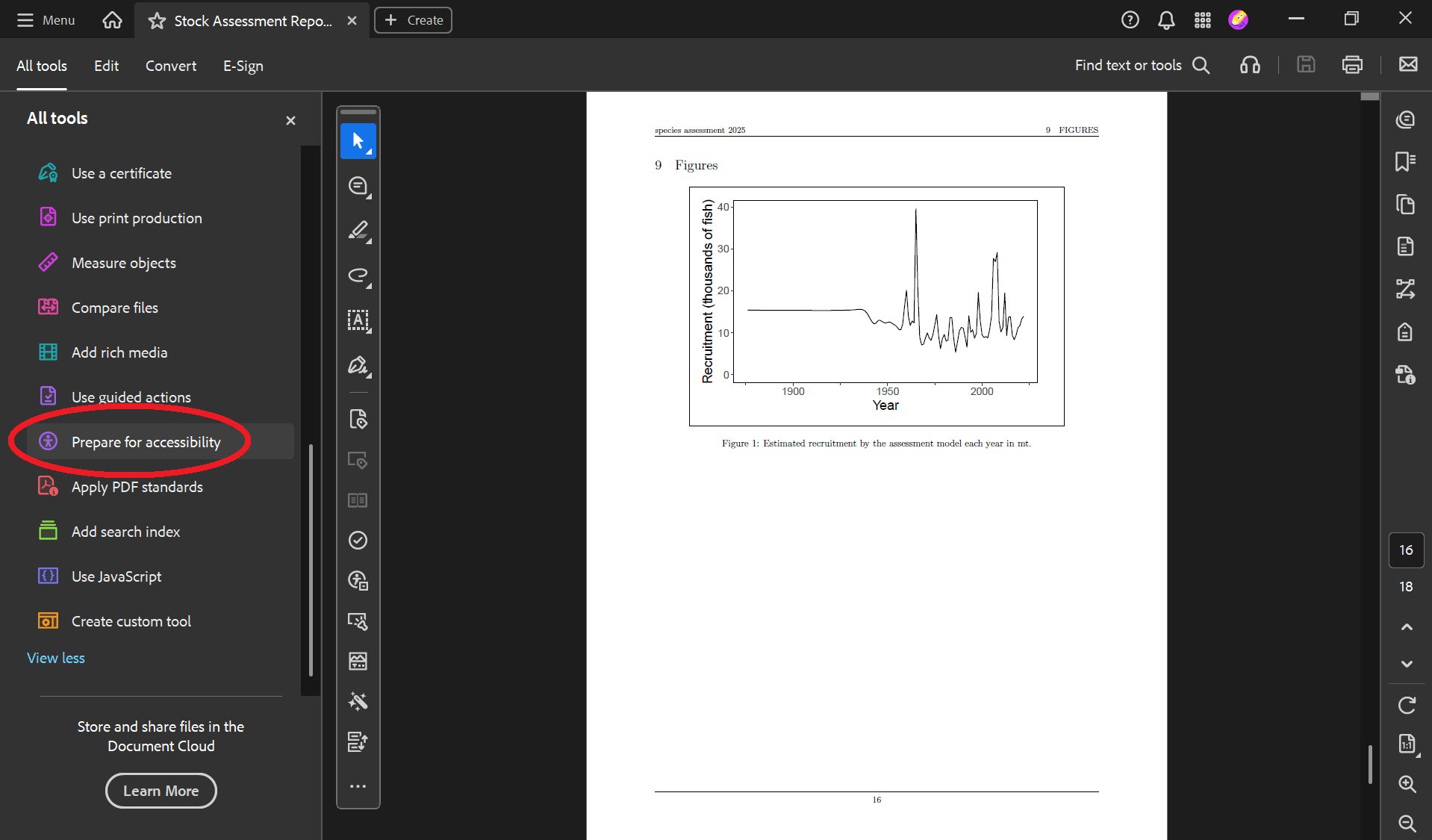
Tip
Check out the “Increasing Report Accessibility” vignette, which contains all kinds of accessibility-related information related to alternative text, using acronyms, learning about the status of accessibility features in {asar} with relation to Section 508 standards, and more.
CautionPractice exercises: Adding accessibility features
If you haven’t already, add tags to your pdf by running
add_tagging()with the appropriate arguments (includingcompileset to TRUE). Then, open up the report and ensure it was tagged.Open up the “captions_alt_text.csv” file that contains your alternative text and captions. Find the rows that are linked with the figures and tables in your report.
- Read through the captions and alternative text. Edit inaccuracies if necessary.
- For figures, add a sentence or two describing the final ingredient for a solid alternative text: the relationship between the variables shown (i.e., what the figure is conveying).
- If you’ve created custom figures/tables, create new rows for each. Add captions for all, and alternative text for just figures. Ensure that the label matches the chunk label.
Run
add_alttext()withcompileset to TRUE. Then, open up the report and ensure the images contain alt text.
Preparing for the Future
Changes to Quarto
We are working closely with Quarto developers to incorporate the accessibility features found in {asar} into the base Quarto software. This means that, in the future, you may not need to use asar::add_tagging(), asar::add_alttext(), or asar::add_accessibility() to add accessibility features to your report. Instead, you may be able to add these features directly within your .qmd files. With that said, we will make sure we maintain compatibility of reports throughout Quarto updates.
Example:
| Current workflow | Potential future workflow |
|---|---|
| 1. {stockplotr} creates csv with alt text and captions in “caption_alt_text.csv” | Identical |
2. asar::create_template() creates figures and tables docs, with chunks that import alt text and captions from the csv file, save them as objects, and positions them in the chunk options (‘fig-alt’, ‘fig-cap’, ‘tbl-cap’) |
Identical |
| 3. User renders skeleton .qmd file | Identical |
4. asar::add_accessibility() inserts captions and alt text from the csv directly into the LaTeX report file created during .qmd report rendering |
Unnecessary |
The Next Assessment Cycle
While {asar} is ready for active use in the next assessment cycle, we are working on additional features to call the assessment from the previous cycle and update it for the new one. This will be the foundation of the workflow as assessments are produced year after year. The workflow presented in this workshop lays out the process for writing an assessment that has not been written yet using {asar} and/or the new standard guidelines.
We are open to suggestions to improve current and future functionality!
Converter Compatibility
We are planning to expand the convert_output() function in {stockplotr} to be compatible with all major U.S. assessment models and then some. In the near term, we plan to expand its functioning to
- WHAM
- sdmTMB
- r4ss
However, there are many bespoke and additional models used by assessment scientists across the U.S. We want to include in the function. This will take a lot of resources, so we appreciate contributions to expand its functionality.
For more information on planned developments and timeline see our GitHub Project and Milestones
Questions, comments, feedback, and closing
Tip
Your colleagues have created some terrific stock assessment reports with {asar}. Check them out on our “Example Reports” page!
Please navigate to this EasyRetro board and tell us what you thought about this workshop. Only 3 simple questions!
- No account is necessary.
- All feedback is anonymous unless you choose to add your name to your comment.
- You can add a thumbs up, and comment, on others’ comments.
Footnotes
Again, for tables that require rotating or splitting across pages, please refer to the “Adding Custom Tables & Figures” vignette.↩︎
{fig-alt="This is the alternative text for my figure", #fig-example}↩︎