Plot spawning biomass with a reference line as a dashed line. The figure can also be made relative to this reference line rather than in absolute units.
plot_spawning_biomass(
  dat,
  geom = "line",
  group = NULL,
  facet = NULL,
  ref_line = "msy",
  unit_label = "mt",
  era = NULL,
  lbs = FALSE,
  module = NULL,
  scale_amount = 1,
  relative = FALSE,
  make_rda = FALSE,
  figures_dir = getwd(),
  interactive = TRUE,
  ...
)
Arguments
- dat
Data frame or list. A tibble or named list of tibbles (input as
list()) returned from convert_output.If inputting a list of tibbles, the first tibble's reference point defined in
ref_lineis used to plot a reference line or calculate relative spawning biomass.- geom
String. Geom used for the plot.
Default: "line".
Options: "line", "point", or "area"
- group
String. Single column that groups the data.
Set group = "none" to summarize data over all indexing values.
Default: NULL Options: Including, but not limited to: "year", "area", "fleet", "sex", "none", NULL
- facet
Character vector. Column name or names used for faceting.
Default: NULL
- ref_line
String or named vector. Reference point name (and value if custom). When multiple models are being compared, a reference line for each model will appear, if desired. The following options can be used to customize the reference line:
all lines are comparing same ref_line = "msy", ref_line = "target", ref_line = "unfished", etc
custom input vector - ref_line = c("sable23_msy"=30, "sable25_msy"=40) – user must indicate which model in label otherwise it will assign in order of dat
input vector of labels - ref_line = c("msy", "target")
Default: "msy"
Options: (including, but not limited to) "target", "msy", and "unfished" If the reference point is not found in the data, set ref_line = c("name" = value).
- unit_label
String. Spawning biomass unit.
Default: "mt"
- era
String. Era of data.
Default: "time"
Options: "early", "time", "fore" (forecast), or NULL (all data)
- lbs
Logical. TRUE/FALSE; indicate whether to convert the y-axis values from kilograms to pounds. The default units match the default in the unit_label argument - 'mt'.
Default:
FALSE- module
Character vector. (Optional) Module name found in
dat$module_name. If selecting >1 module, place them in a vector like c("module1", "module2").Default: NULL
If the interactive and >1 module_name is found, user will select the module_name in the console. @seealso
filter_data()- scale_amount
Number. A number to scale the y-axis values.
Default: 1
- relative
Logical. TRUE/FALSE; specify whether to set y-axis values relative to the ref_line value.
Default:
FALSE- make_rda
Logical. TRUE/FALSE; indicate whether to save the object and make an automated caption and alternative text in the form of an
rdaobject. If TRUE, the rda will be exported to the folder indicated in the argument "figures_dir".Default:
FALSE.- figures_dir
Path. Path to the "figures" folder.
Default:
getwd()The folder is created within the path if it does not exist.
- interactive
Logical. TRUE/FALSE; indicate whether the environment is interactive.
Default:
FALSE- ...
Arguments called from geom_line or geom_point
Value
A plot showing spawning biomass over time.
Details
The input is from an assessment model output file
translated to a standardized output (convert_output).
There are options to return a ggplot2 object or export an .rda object
containing associated caption and alternative text for the figure.
Note
All plotting functions automatically recognize indexing variables and will
use them in groupings and/or facetting. @seealso process_data().
See also
Examples
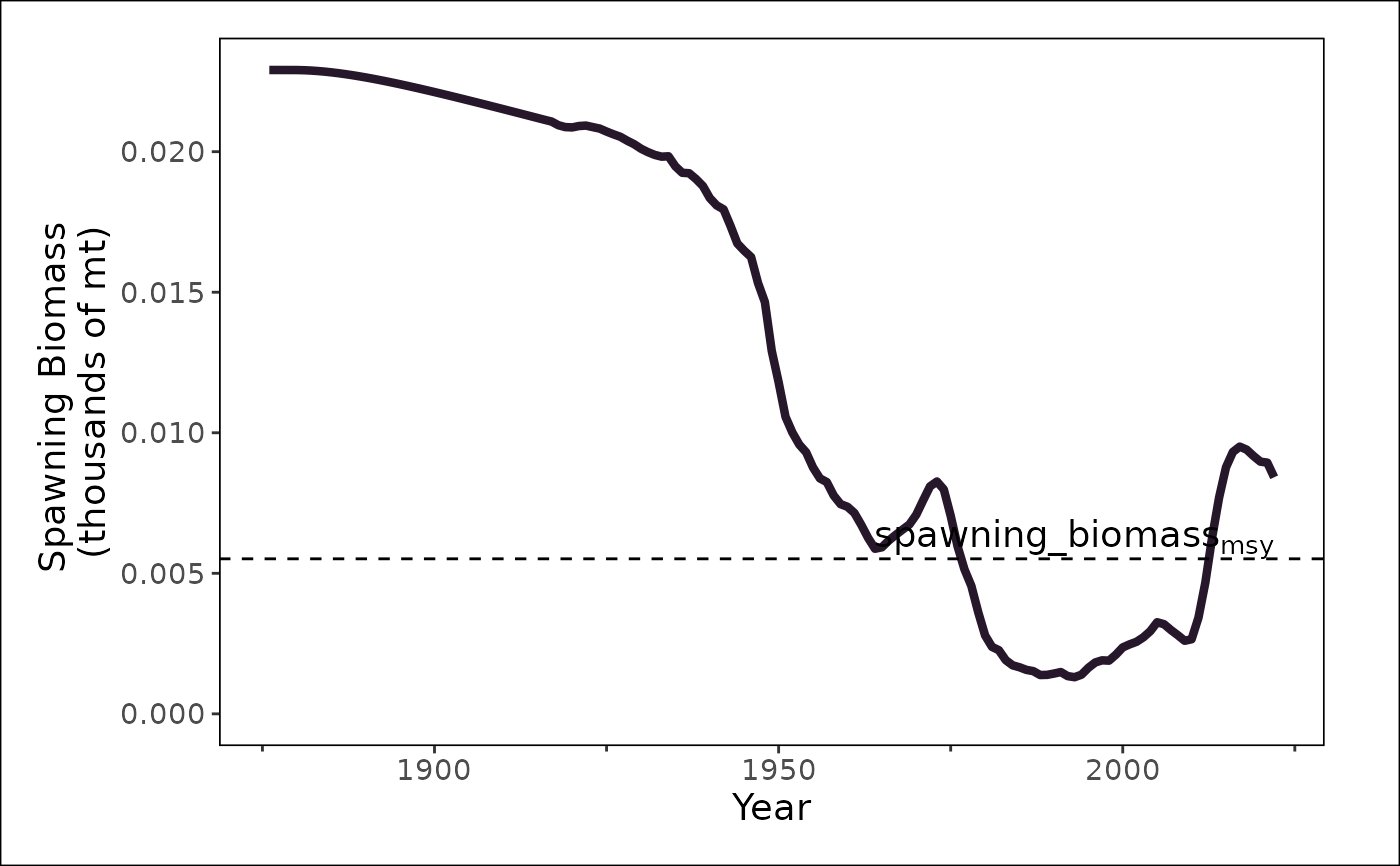
plot_spawning_biomass(
dat = stockplotr:::example_data,
geom = "line",
ref_line = "msy",
unit_label = "mt",
scale_amount = 1000,
interactive = FALSE,
module = "TIME_SERIES",
linewidth = 1.5
)
#> Ignoring unknown labels:
#> • linetype : "Growth_pattern"
#> • shape : "Growth_pattern"
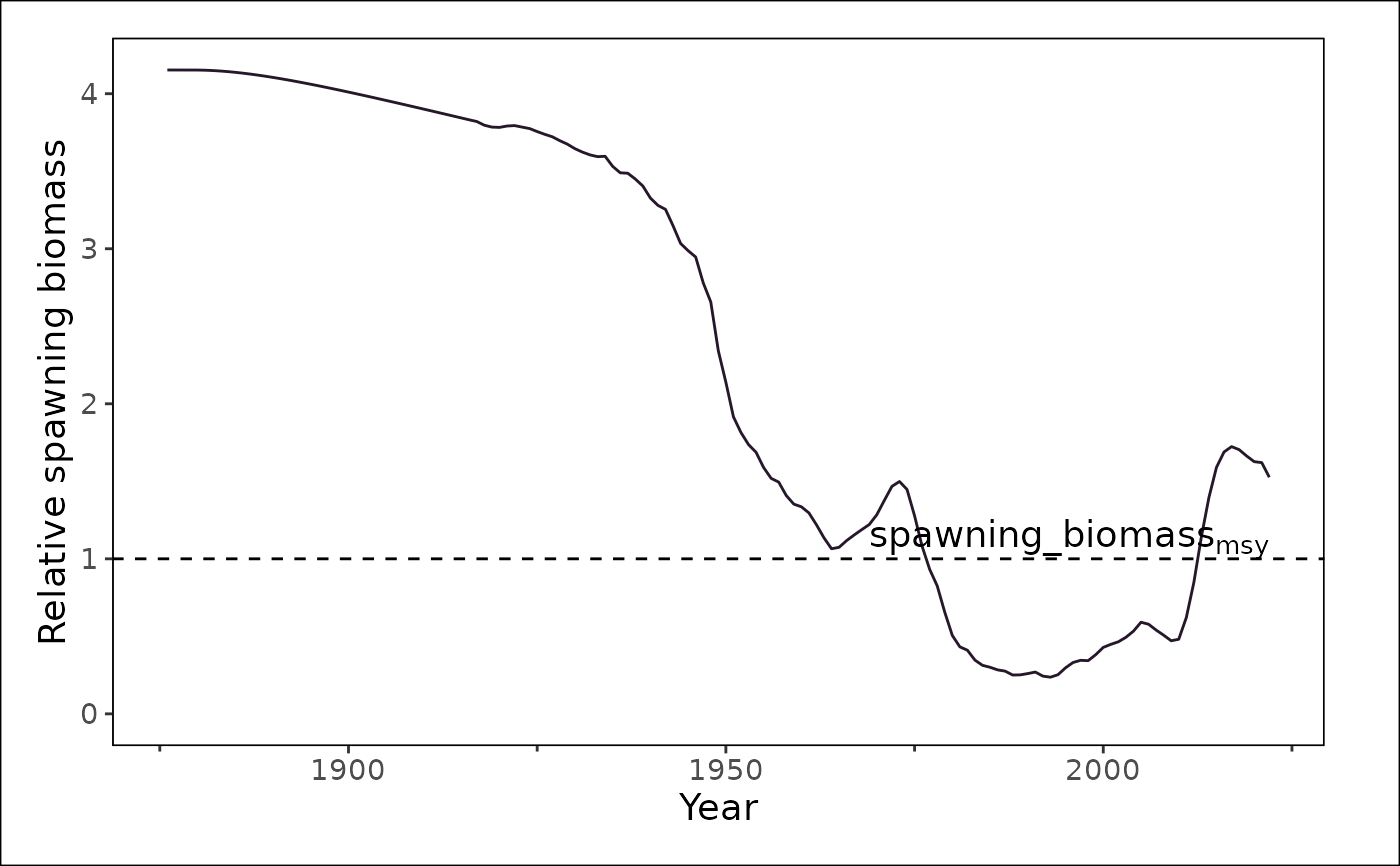
 plot_spawning_biomass(
dat = stockplotr:::example_data,
ref_line = c("target" = 10),
interactive = FALSE,
module = "TIME_SERIES"
)
#> Ignoring unknown labels:
#> • linetype : "Growth_pattern"
#> • shape : "Growth_pattern"
 if (FALSE) { # \dontrun{
plot_spawning_biomass(
dat = list("2023" = model1, "2025" = model2),
ref_line = c("SBF30" = 1500, "SBF40" = 2300)
)
} # }