Presentations & Publications
Presentations
Passive acoustic gliders as a complement to ship-based marine mammal surveys, Underwater Glider User Group Workshop 2026
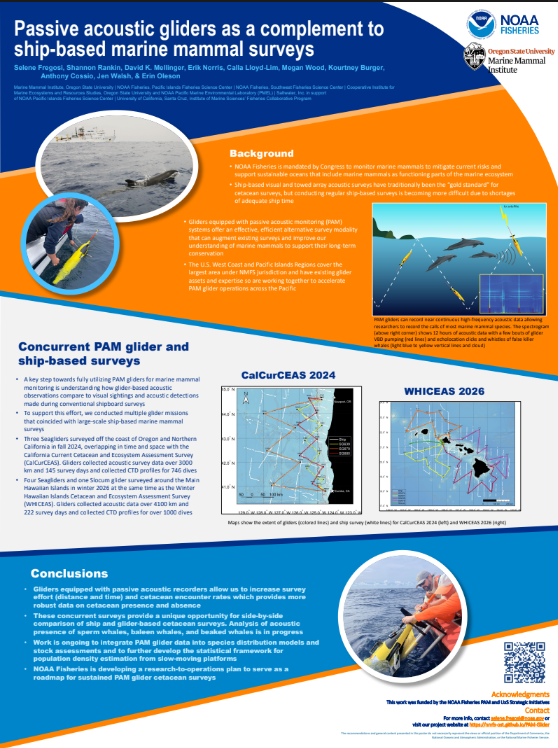
Selene Fregosi, Shannon Rankin, David K. Mellinger, Erik Norris, Calla Lloyd-Lim, Megan Wood, Kourtney Burger, Anthony Cossio, Jen Walsh, Erin M. Oleson
Abstract Buoyancy-driven underwater gliders equipped with passive acoustic recorders are an increasingly important tool for marine mammal monitoring. Gliders can operate year-round, access remote offshore regions, and collect high-frequency recordings suitable for detecting most marine mammal species. As a result, the U.S. National Marine Fisheries Service is working to use passive acoustic monitoring (PAM) gliders to augment traditional ship-based visual and acoustic surveys in the Pacific. A key step in this application is understanding how glider-based acoustic observations relate to detections made during conventional shipboard surveys. To support this effort, multiple deployments have been conducted to coincide with large-scale ship-based marine mammal surveys. In fall 2024, three PAM gliders surveyed more than 3,000 km over 145 survey days along the U.S. West Coast, overlapping in time and space with a portion of a ship-based marine mammal abundance survey off Oregon and California. Similarly, in winter and spring 2026, five PAM gliders conducted deployments of up to 12 weeks throughout the Main Hawaiian Islands concurrent with a ship-based survey. These coordinated efforts provide a unique opportunity to evaluate how glider-based PAM can complement traditional survey methods while expanding spatial and temporal coverage. This presentation will describe the survey design, operational coordination between glider and ship platforms, and the broader effort to incorporate glider-based PAM into sustained marine mammal monitoring programs in the Pacific.
Links: Poster
NOAA Fisheries Glider Challenge: Accelerating the Use of Passive Acoustic-Equipped Gliders to Monitor and Assess Cetacean Populations in the Pacific, Underwater Glider User Group Workshop 2026
Erin M. Oleson, Shannon Rankin, Selene Fregosi, Kourtney Burger, Anthony Cossio, Calla Lloyd-Lim, David K. Mellinger, Erik Norris
Abstract: Profiling gliders equipped with passive acoustic monitoring (PAM) sensors have been used in several marine mammal monitoring applications, often focused on identifying marine mammal occurrences to understand animal distribution or for threat mitigation. Building on this prior work, the U.S. National Marine Fisheries Service (NMFS) is carrying out a multiphase effort to accelerate the transition from research and development to operational marine mammal surveys using PAM-gliders in the Pacific. The first phase of this effort was the NMFS glider challenge, launched in Hawaii in January 2026. Concurrent in-water instrumentation testing included Seagliders, the Hefring Oceanscout provided by Cornell University, the Alseamar SeaExplorer, and Teledyne Slocum gliders equipped with DMON, WISPR, and JASCO acoustic sensors. Eight gliders carrying a variety of PAM packages navigated a figure-8 track offshore of Oahu, Hawaii over a 2 week period. The track included multiple phases designed to examine trade-offs between survey design, noise levels, sensor combinations, and piloting and navigation for survey-specific objectives. This “glider rodeo” is one part of an intensive research-tooperations program focused on quickly accelerating NMFS use of uncrewed systems to augment or replace ship-based marine mammal, ecosystem, and fisheries surveys across vast regions of the Pacific where ship surveys are logistically difficult and sustaining the necessary survey frequency is cost prohibitive. This presentation will describe the initial results of the glider rodeo, including basic performance metrics and findings that are guiding NMFS’ future investments in PAM-equipped gliders.
Links: Slides
Development of a Pacific-wide Passive Acoustic Glider Program to Augment Cetacean Surveys, Protected Species Assessment Workshop 2025 (PSAW IV)
Selene Fregosi, Erin Oleson, Erik Norris, Shannon Rankin, Kourtney Burger, Anthony Cossio, Jen Walsh, David Mellinger
Abstract: A collaborative effort between PIFSC, SWFSC and OSU/PMEL aims to accelerate NMFS’s use of passive acoustic monitoring (PAM) glider surveys to augment existing ship-based surveys for cetacean stock assessment. This effort builds on historically successful efforts by NMFS to use PAM-equipped gliders including studies of endangered right whales off the U.S. East Coast and odontocetes around the Main Hawaiian Islands. This previous work highlighted the feasibility of using PAM-equipped gliders to bolster data collection efforts for cetacean surveys. Use of gliders is of particular interest in the Pacific region, which is the largest area under NMFS jurisdiction and is subject to acute shortages of adequate ship time; therefore, this region must identify survey modalities that maintain assessment operations over as large an area as possible. While the initial effort is focused in the Pacific region, this project will result in a Research-to-Operations plan that can be adapted or applied in other regions. Primary goals of this work are to (1) build capacity to sustain glider operations within NMFS through purchasing equipment, developing infrastructure, and hiring piloting and technical staff; (2) conduct detailed in-water instrumentation testing and comparison of currently available glider and sensor types to provide guidance for various use cases; (3) conduct concurrent glider and shipboard surveys off both the U.S. West Coast and Main Hawaiian Islands which will provide a unique opportunity to compare these two data streams; and (4) advance animal distribution modeling methods to integrate the PAM-glider collected data into stock assessments.
Links: Slides, [Video]
Also presented at ASA Honolulu December 2025
NOAA Fisheries’ Strategy for Passive Acoustic Gliders, UG2 Workshop ’24
Shannon Rankin, Christian Reiss, Erin Oleson, Selene Fregosi, David K. Mellinger, Erik Norris
Abstract: NOAA Fisheries has developed a strategic goal of investing in passive acoustic monitoring (PAM) from underwater gliders as part of an effort to build a dynamically managed fisheries system that accounts for climate change and supports science- based management and conservation. PAM-equipped gliders provide an autonomous solution to collecting encounter datasets for vocal species that can serve NMFS assessment needs. With dedicated R&D effort, PAM-equipped gliders can augment and replace some ship-based survey efforts, informing climate assessments, including changes in range or space use, and quantitative metrics, including population density. As part of this strategic initiative, NOAA Fisheries will lead a 3-year effort to accelerate the transition to operations for PAM-based glider surveys. The goal will be to develop a research-to-operations plan to implement PAM-equipped glider surveys that support their marine mammal assessments. The effort includes (1) the Glider Rodeo, (2) concurrent glider and shipboard surveys, and (3) the Plankton to Whales project. The Glider Rodeo [see associated presentation], involving in-water testing of several PAM-glider systems, has the goal of examining glider and sensor choices and how these choices may vary based on regional differences in assessment needs and oceanographic realities. The concurrent surveys include deploying several PAM-equipped gliders in association with two large-scale assessment surveys: PacMAPPS West Coast in 2024 and PacMAPPS Hawaii in 2026. These surveys provide an opportunity to collect glider datasets that can be compared alongside traditional cetacean survey data to guide future survey design and analytical advancements. The Plankton to Whales project is a pilot study that will provide seasonal autonomous ecosystem sampling from plankton to whales using paired PAM and oceanographic gliders with shadow- graph sensors for observing plankton.
Links: Slides
The Glider Rodeo: NOAA Fisheries’ Passive Acoustic Underwater Glider Comparison, UG2 Workshop ’24
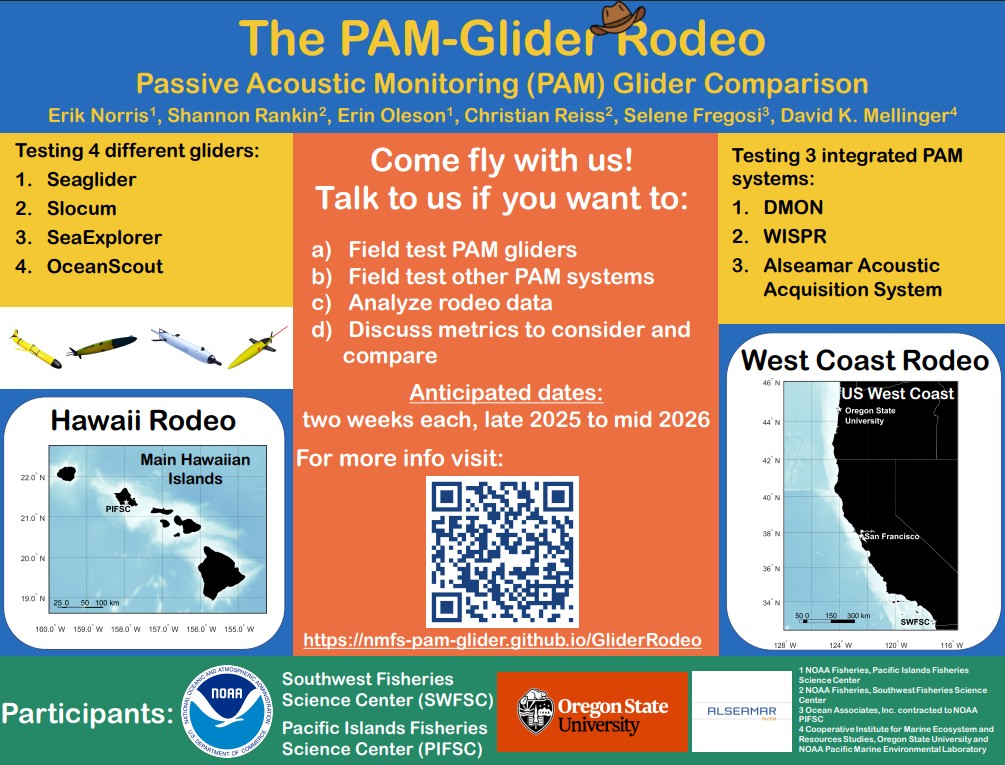
Erik Norris, Shannon Rankin, Erin Oleson, Christian Reiss, Selene Fregosi, David K. Mellinger
Abstract: As part of a strategic goal to invest in passive acoustic monitoring using the uncrewed systems strategic initiative, NOAA Fisheries is pursuing field tests of several underwater gliders equipped with passive acoustic monitoring (PAM) systems. These tests will take place during two 2-week ‘glider rodeos’ planned for the U.S. West Coast and Hawaii in 2025-2026. Testing will include Slocum (Teledyne Webb), Seaglider (Univ. Washington), OceanScout (Hefring), and SeaExplorer (Alseamar) platforms with DMON, WISPR, and Alseamar acoustic acquisition systems. A pre-designed survey path will allow resampling of the same area by each glider over each 2-week effort to maximize spatial and temporal overlap. Glider performance and acoustic recording and detection metrics will be measured for each system to enable comparison and inform future glider acquisitions and use by NOAA Fisheries. Metrics under consideration include survey, data quality, and acoustic metrics. This is a unique opportunity to examine the performance and capability of a diverse set of currently available PAMequipped underwater gliders, and we welcome community input into test design and assessment metrics. There may be unfunded opportunities for participation to compare other systems if they are provided, and we will offer logistical support when possible. Results will be made publicly available to inform future research and development.
Links: Poster